


My Mama and Dada are fools. Wait. Perhaps I should clarify. My Mama and Dada act like fools when they read with me. They’ve acted this way since they first began reading to me, and it’s part of the reason why I love reading with them so much. They add noises wherever they possibly can. They add noises that don’t even exist in real life, all so I will engage in the books they read. And the noises work! I love books with lots of possible sound effects, and now that I’ve begun my own pretend play scenarios, I use the sounds myself.
Here are some of the books that provide plenty of opportunities for both animal sounds and other noises that my Mama and Dada read to me when I was really little:
- Mr. Brown Can Moo, Can You : Dr. Seuss’s Book of Wonderful Noises (Bright and Early Board Books)
: Not just animals, but all sorts of fun sounds
- Doggies (Boynton on Board)
by Sandra Boynton: Counting dogs and their barks–what could be better?
- Moo Baa La La La
by Sandra Boynton: Great animal noises–ham them up!
Here are a few books that I liked when I got a little older:
- The Very Busy Spider
by Eric Carle: Good opportunities for animal sounds
- Little Blue Truck Board Book
by Alice Schertle and Jill McElmurry: Animal sounds, but also lots of friendly “beeps!” and a grumpy dump truck voice
- We’re Going on a Bear Hunt (Classic Board Books)
by Helen Oxenbury and Michael Rosen: Good book for repetition and “other” noises beside animal sounds
- Dinosaur Zoom!
by Penny Dale: Dinosaurs, all different kinds of cars and trucks (with great sound effects), and a surprise at the end. The illustrations are fantastic, too!
Here are a few other sounds that my Mama and Dada use throughout the books we read:
- up and down (brrrrrrp with ascending and descending pitch)
- walking (doot doot doot with fingers walking)
- running (huffing and arms swinging)
- doors opening (creeeeeak)
- falling down (thump or ka-boom)
- cars or go (vroom)
- stop (errrrrrr! Or screeeech!)
- wind blowing (hooooo)
- rain (pshhhhh with fingers wiggling up to down to mimic rain)
- squirrels (sing-song “squirrel, squirrel, shake your bushy tail” and have child wiggle)
- flowers (sniff flowers and have child sniff, too)
Act the fool! Add sounds wherever you can. They draw in little guys and gals like me and help us really enjoy reading with you!
–Luke (blog co-star, age two and a half)
 because the turn of events at the end makes me laugh every time.
 )
) This book’s main character, the duckling, has an ingenious way of off-loading his nut-laden cookie onto his less-than-mature nemesis, the pigeon.
 perfectly captures the ridiculousness of the escalation that occurs when a toddler wants something he can’t have. It’s stinking hilarious. Even to the toddler reading it who is being mocked.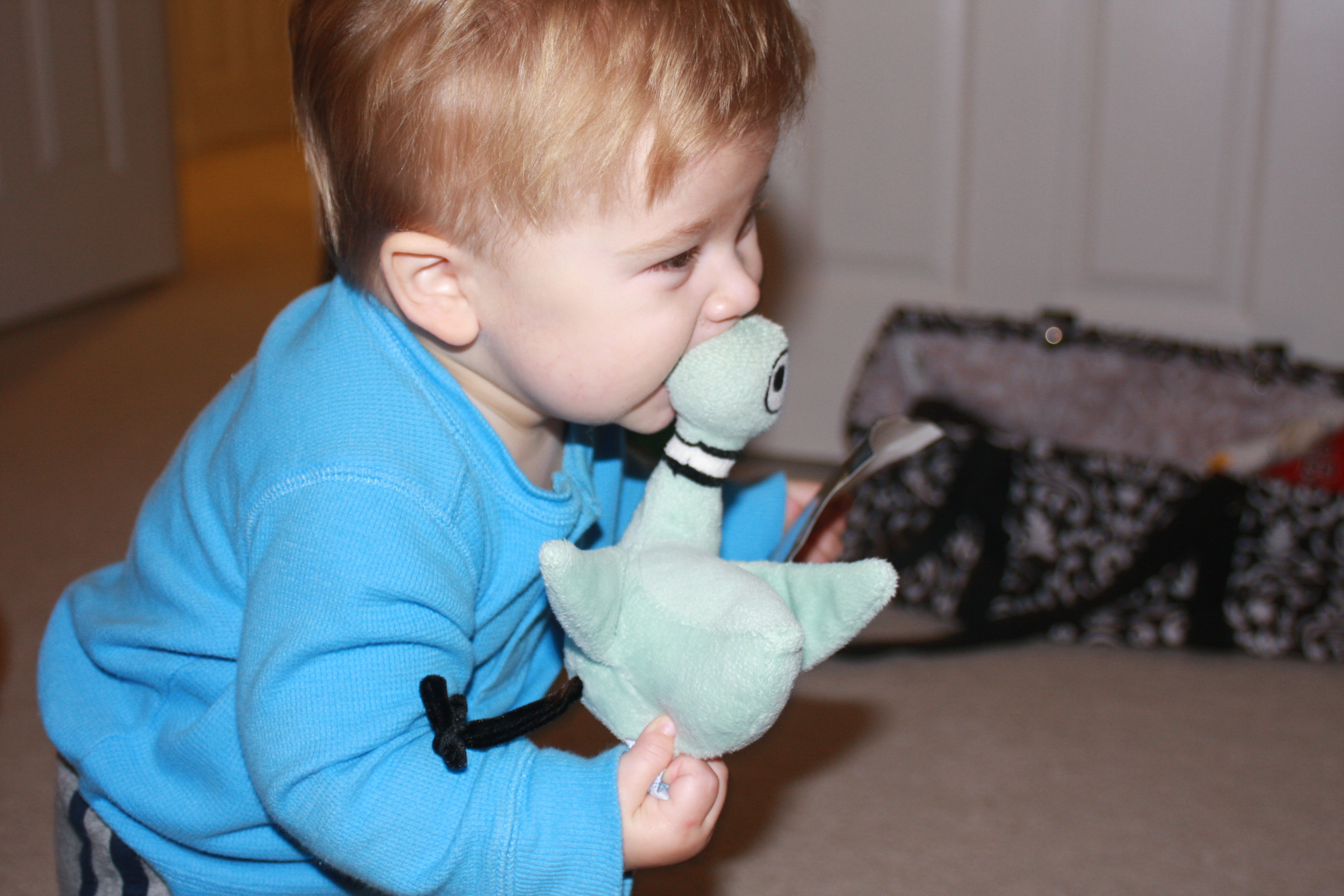


 : Clearly a classic, but I loved it because my Mama used signs and sounds throughout the book. Moon sign, sun sign, eating sounds, and caterpillar sounds (ee, er, ee, er) and finger inching like a caterpillar. My favorite part of the book was always the beautiful butterfly at the very end. My Mama loved talking about all of the colors on its wings.
 ot Book: Dr. Seuss’s Wacky Book of Opposites
 by Sandra Boynton: I loved this book for two years! The rhyme and rhythm are both so catchy, and there are so many things to do and talk about with this little gem. My favorite part was “Pajammy to the left, pajammy to the right! Jamma, jamma, jamma, jamma, P! J!” Mama would dance me to the left, to the right, and then bounce me a little on the P! J! Sandra Boynton is a genius.


 : Various nursery rhymes (repeated over and over and over again): I like the collection illustrated by Engelbreit because the rhymes are formatted one to a page and the illustrations are very bright and colorful.
 Paula Wiseman Books)
 lphabet City
 b
b y Adam Rex: A girl visits the zoo and the animals each ask her for something very specific. You don’t find out until the very end what they use everything for!
 morebooksmama