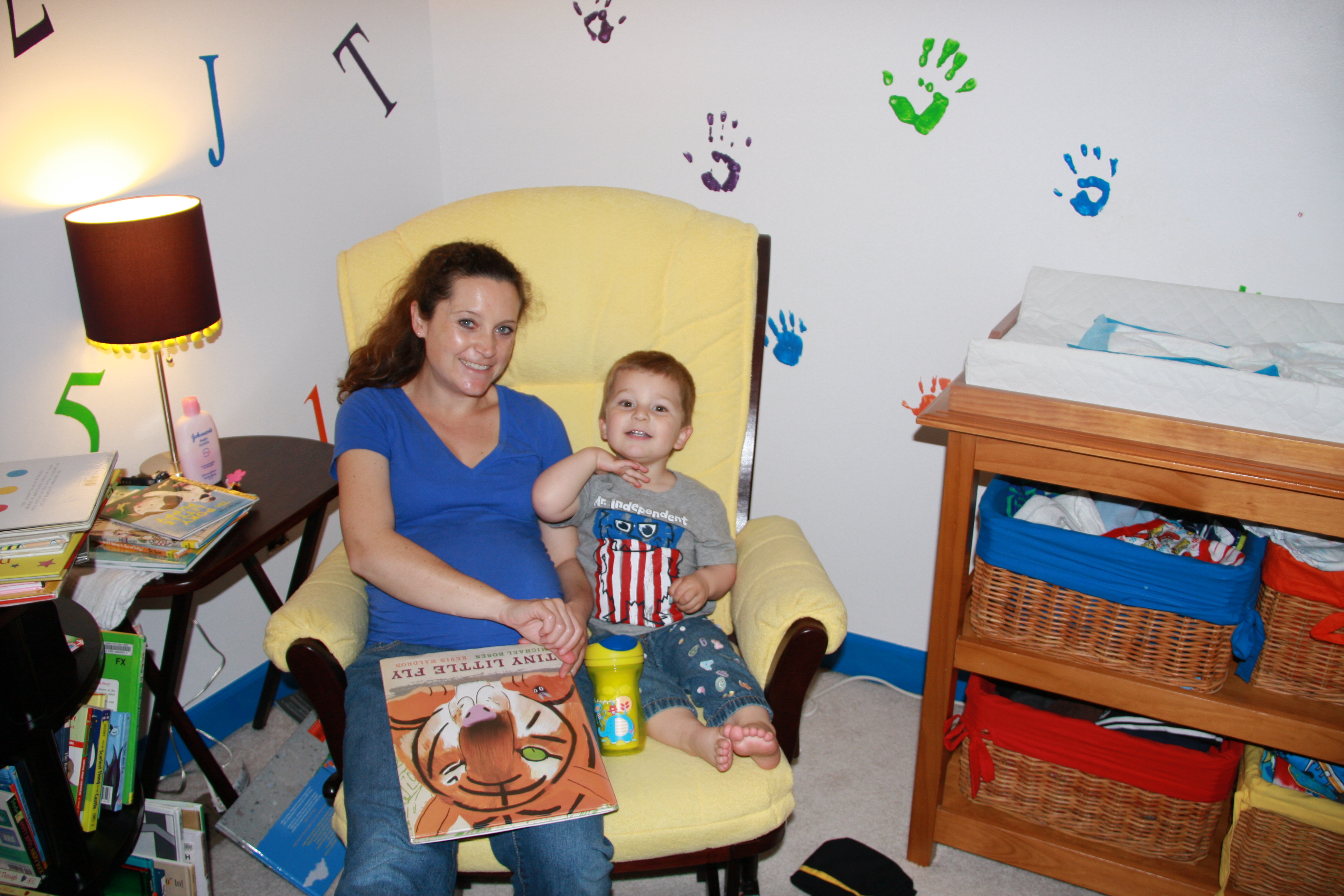
“Reading is no doubt one of the most important academic skills a child must master to be successful throughout her life. Reading, more than any other skill, is the key to learning in every academic discipline. Whether the subject is math, science, or social studies, reading is critical throughout a child’s school day. And no matter how much potential a child has for these subjects, without good reading skills her opportunities will be limited. To do well in school, children must read well.”

–from Baby Minds by Linda Acredolo and Susan Goodwyn


No pressure, right?  The most important first step toward helping a child read well, though, is also the easiest: make reading fun!  Use sounds, use different voices, use inflection, and choose engaging books.  If you’re enjoying reading, then your child is most likely enjoying it, too!

Books Forever!

–Erin (blog Mama and co-author)

Reading Tip: Of Squeaky Mice and Growly Monsters: Using Voices to Engage Children in Books

“Read, every day, something no one else is reading. Think, every day, something no one else is thinking. Do, every day, something no one else would be silly enough to do. It is bad for the mind to be always part of unanimity.”  Christopher Morley (1890 – 1957)

Low, growly monster voices; high-pitched teeny tiny bug voices; scared, trembly voices; bad British accents; “whoo whoo” owl voices; hisssssing sssssnake voices; bubbly fish voices; squeaky mouse voices.  Mama and Dada do all of these and more when they read with me.  It’s quite entertaining listening to them contort their voices for my reading pleasure!  The best part is that they do all of these voices without a trace of embarrassment because they know that as soon as I hear a funky sound or voice I’m instantly hooked.

Here are a few books that work really well with voices, usually because they have multiple characters and each character needs its own distinct voice:

   I Love You, Stinky Face by Lisa McCourt and Cyd Moore:  My first “voice” book!  Gorilla gets a low, monster voice with lots of “ooo-ooo, aaa-aaas;” alligator gets “chomp chomp” sounds with chomping arm motions; skunk gets a nasally “smelly” voice (“ewww!” with lots of nose-wrinkling); alien gets a fast, high-pitched voice and lots of “ewwws!” when he eats bugs instead of peanut butter; dinosaur gets eating noises; and the one-eyed monster gets a low, growly voice with “boom, booms!” to emphasize his stomping.  A favorite of mine from about ten months old to two years old.

  The Pout-Pout Fish (Pout-Pout Fish Adventure) by Deborah Diesen and Dan Hanna:  “I’m a pout-pout fish with a pout-pout face…”  What a fun book for creative voices: pout-pout fish gets a low, sad, slow, gloomy voice; clam gets a prim little voice; jellyfish gets a wavering voice pitched up and down to mimic undulating tentacles; octopus gets a no-nonsense, tough guy voice; and squid gets a lady-with-an-attitude voice.  I really like this book and have been reading it with my parents for well over a year now.

  The Gruffalo (Picture Books) by Julia Donaldson and Axel Scheffler: Another fun book to read with multiple voices for the different characters.  Mouse could get a squeaky voice, but Mama usually reads Mouse in her regular voice.  Fox gets a very bad British accent (don’t ask me why–something about fox hunts among the royalty in British literature); owl gets lots of “whoo-whooing” and extended “o”s wherever they occur; snake gets a hissing voice with elongated “s” sounds; and the Gruffalo gets a rough, gravelly voice.  Using voices made this story more accessible for me when I may not have been quite old enough to entirely grasp the nuances of the very clever plot line.

  Gorilla! Gorilla! by Jeanne Willis and Tony Ross: There are minor characters that appear briefly throughout the book that you can give voices to, but the two main characters, Mama Mouse and Gorilla, are the two that Mama focuses on the most.  Mama Mouse gets a high, panicky voice to mirror how stressed out she is being chased around the world by a gorilla, while Gorilla gets a low, gravelly voice, loud and emphatic for all of the “STOPs!” and kind and gentle at the end for the surprise twist.

  Bye-Bye, Big Bad Bullybug! by Ed Emberley:  A good book for starting with voices because there are only two kinds of characters: the Big Bad Bullybug and the itty bitty baby bugs.  Mama and Dada use their “monster” voice for the Bullybug (rough, growly, and low), and a high-pitched, almost whiny voice for the itty bitty baby bugs.  A good book for tickles with a fun surprise ending.

  The Cat in the Hat by Dr. Seuss:  For spicing up this already awesome classic, Mama and Dada give unique voices to each of the main characters.  Mama and Dada’s voices differ a lot for these characters though.  For the Cat, Mama does a jolly, slow, deep voice, while Dada does a deep voice with a playful don’t-take-me-too-seriously lilt.  For the Fish in the Pot, Mama does an annoying, high-pitched voice that makes the Fish sound like it’s strenuously objecting to the Cat, while Dada does a gravelly, low voice using lots of inflection for the objecting.  Although Thing 1 and Thing 2 only speak a few lines, Mama makes them talk very quickly and frenetically, imitating how they dart and flit around the house with their kites.

Clearly, these voices are just suggestions.  The best voices are the ones that parents make up for themselves that they are comfortable with and can remember (just try using a different voice after a toddler has heard and liked another!).  Act silly and without embarrassment: the only one who will know what you sound like will be your child, and he or she will love you (and books) all the more for it!

Happy reading!

–Luke (blog co-author, age 2.5)


The Birthday Book Post: Books We Have Given

For one reason or another, many of my little friends have birthdays in May.  This slew of birthdays has inspired me to post a list of the books that I have given to others for their birthdays over the past three years.  I consider these books the “best of the best,” otherwise I wouldn’t pass them on!  Books are arranged by the ages of the children to whom I gifted the books, but that doesn’t mean that older children wouldn’t enjoy them as well….

FOR ONE YEAR OLDS:
  Pete the Cat: I Love My White Shoes by James Dean and Eric Litwin: I don’t know a little one who doesn’t like Pete the Cat!  Pete has a new pair of white shoes, but he keeps stepping in different colored things (strawberries, blueberries, etc.).  “Does Pete cry?  Goodness no! He keeps walking along singing his song.”  I loved that this book could be read with tons of inflection and that Mama and Dada sang (I use the word loosely) the little ditty that Pete sings.  Fantastic for kids learning their colors.

   Don’t Let the Pigeon Drive the Bus! by Mo Willems:  I’m not sure how many times I can post this book before I get in trouble for copyright infringement.  This book is great for little ones because of the big text, inflection, and funny storyline.  See Mo Willems post for more info!

FOR TWO TO THREE YEAR OLDS:

  Snip Snap!: What’s That? by Mara Bergman and Nick Maland:  One of my all time favorite books just before I turned two!  Lots of fun noises for parents to make, a jaunty rhyme, nice repetition, and an alligator on the loose make this book a sure hit.  There is a great close up of the alligator that always made me laugh, too!

  If I Were a Lion by Sarah Weeks and Heather Solomon: Another huge favorite of mine!  A spunky little girl is in time out for making a huge mess and her mother dubs her “wild.”  The rest of the book is the girl protesting that if she were truly wild, she’d do all of these “wild” things like “poke and pierce and tear, not sit here nicely in my chair.”  Great rhyming text, expressive illustrations, and, of course, the little girl is the quintessential toddler: equal parts mischief and sweetness.  (She does apologize and say sorry at the end!)

  Gorilla! Gorilla! by Jeanne Willis and Tony Ross:  Definitely a fun book for toddlers who can talk (or at least yell, “STOP!”).  A mother mouse’s baby goes missing, but as mama is looking for him, a giant gorilla yells, “Stop!” at her.  She takes off running, of course, and that begins a chase across the globe.  In the end, the gorilla turns out to be a great guy who found her baby and has been trying to give him back the entire time.  Nice repetitive text, opportunities for audience involvement, and a surprise ending make this book another fun read for both parents and kids.

FOR THREE TO FOUR YEAR OLDS:
  Creepy Carrots! by Aaron Reynolds and Peter Brown:  What a fantastic book!  Jasper Rabbit is obsessed with carrots, and he picks them from a field every day.  One day, however, the carrots start following him, “tunk tunk tunk…” or do they?  Jasper sees carrots everywhere, but with Peter Brown’s clever illustrations, neither Jasper nor the reader is entirely certain whether the carrots are really there.  Finally, Jasper hatches a plan to ensure that those carrots never bother him again, but it is the carrots who get the last laugh!  Black and white illustrations with only splashes of orange for the carrots lend a Twilight Zone feel to the book.  Entertainingly suspenseful text, too!

  The Gruffalo (Picture Books) by Julia Donaldson and Axel Scheffler:  Another great book with a clever twist at the end!  Everyone wants to eat Mouse, but he foils them all by making up an imaginary creature called a Gruffalo who loves to eat the other animals.  Mouse soon discovers that the Gruffalo DOES exist, and it’s hungry for mouse, too!  But Mouse is pretty darn clever, and he fools the Gruffalo just like he did the other animals.  Nice repetition, catchy rhyme, and Mouse’s cleverness make this book tons of fun for both parents and kids!

  Ladybug Girl by David Soman and Jacky Davis:  I liked this book for a very long time.  Lulu may dress like Ladybug Girl, but she is a spunky girl with a can-do attitude.  When her brother refuses to play with her one morning, Lulu makes her own fun and proves to the world that she is NOT too little to do big things (like save ants, count letter Ls, and rebuild rock walls).  This book encourages kids to be independent, use their imaginations to entertain themselves, and leave their own pint-sized impact on the world.  Illustrations and language are both wonderful.

Happy gifting!

–Luke (age 2.5, blog co-author)


To My Son on Mother’s Day: A (Bookish) Love Note

Dear Luke,

Until I started teaching, my relationship with reading was almost an entirely selfish one.  When I began sharing literature with my students, reading became two dimensional: analyzing a text with others and sharing my passion for a piece added an undeniable richness to the experience. Since I started reading with you, however, the act of reading has achieved a third dimension that is absolutely intoxicating.  What is it about this third dimension that is so amazing?  Allow me to try to explain.

Before you, reading was all about absence.  Escape.  Removing myself from the “real” world and submerging myself in another.

After you, reading has become all about presence.  Being fully present in every moment of our reading time.  Reveling in your curiosity, your questions, your observations, your undeniable interest in letters, numbers, words, and stories.  Paradoxically, by immersing myself in our reading time, I achieve the same sense of escape from reality, but it is with you as my traveling companion.

Before you, reading was about being alone.  It was a solitary act.  Even when reading a novel with high school students, the students were expected to come to class having read a portion of text and then we would discuss it.  Usually, we did not read the text together.

After you, reading has become about being together.  With you, I have discovered the pleasure of sharing words and ideas much more viscerally.  In an immediate way that was never possible with students, except for an occasional close reading done in class, together you and I explore the nuances and details and questions and morals of your stories, each of us interacting closely with the other.

Before you, reading was primarily a self-investment.  It was about me.  Through critical thinking about ideas, close analysis of beautiful writing, and pure enjoyment of a well-told story, I could return to myself and reestablish my identity as a thinker and a student of the human experience.  (Reading by myself still plays this role, albeit on a much smaller scale…for now!)

After you, reading has become an investment in YOU.  An investment in your future.  I hope that you are soaking up a love for words, stories, and ideas; cultivating a passion for the act of learning, for knowledge, and for beauty; and developing the insatiable curiosity, the ability to make connections, and the thoughtfulness that will bring you both great personal satisfaction and serve you well as a citizen of the world.

Before you, Luke, I really enjoyed the act of reading because it was fun.

After you, I love reading because it helps me grow closer to you.

At the beginning of this letter, I wrote about how reading with you has opened up an intoxicating third dimension. Why so intoxicating? I think I’ve figured it out.  Reading with you is done with Love.

Love,

Mama

Reading Tip: Hubba-whaa?!? Engaging Children in Books Using Inflection

In addition to adding sounds to our readings, the best thing about reading with my Mama and Dada is that they REALLY get into my books using their voices.  They emphasize important words by speaking louder, making their voices go up or down in pitch, or drawing out certain syllables.   In other words, they use tons of inflection.  Talk about EN-ter-TAIN-ing!

But reading with inflection isn’t just about entertainment: it also helps me to begin associating written letter combinations with their sounds (e.g. “ph” makes an “f” sound), to pronounce words, and to better understand the story.  I also learn an important strategy for decoding new words: sounding out words by segmenting them into syllables.  When my parents run their fingers under the words as they read, it helps me make all of these associations even more easily.  And now that my Mama and Dada have been reading with inflection for so long, I’ve started reading like that myself (which is totally entertaining for them!).

Using inflection is a part of every book that we read, but some authors go out of their way to make it very easy to do.  These books are always among my favorites, mostly because they are so fun to hear.  Here are a few to get you started.  Books are ordered from least to most complex, but I still enjoy even the simplest of them.

  What Will Fat Cat Sit On? by Jan Thomas: If you’re new to the whole inflection thing, this book is a great one to start with.  The illustrations are simple and expressive, and the text is spare, very big, and deliberately constructed to emphasize certain words.  Oh yeah, the book is also hilarious.  A good book for practicing running your finger under the text, too.  Other Jan Thomas books work equally well (The Doghouse is another of my favorites), but this one was my first Jan Thomas book and remains my favorite.

  The Duckling Gets a Cookie!? (Pigeon) by Mo Willems: Another fantastic book that is perfect for exaggerated readings.  Similar to What Will Fat Cat Sit On, the illustrations are simple, the text spare, and the type helps tell you how to read it with inflection.  It’s also pretty darn funny, as are all of Mo Willems’s books.  If this particular book doesn’t appeal to your child, try any of Willems’s books (Don’t Let the Pigeon Drive the Bus and the Elephant and Piggie books are other favorites of mine).

  The Monster at the End of This Book (Sesame Street) (Little Golden Book) by Jon Stone and Michael Smollin: Another long-time favorite, Monster shares the same text elements as the first two books in this list: large font with emphasis built into the type to make it very easy to read with inflection.  As an added bonus, Grover talks to the reader, begging and pleading to not turn the page.  I love this book in part because it is interactive.

  Unicorn Thinks He’s Pretty Great by Bob Shea: This book is geared toward a slightly older toddler (3-5).  The language is more advanced and the dialogue between the two characters, Goat and Unicorn, takes a few readings for a toddler to figure out.  (Tip: Mama adds in “Goat says…” and “then Unicorn says” to make the exchanges between characters a little easier to understand)  Once you figure out the dialogue, however, the book is really fun to read.  Emphasis on certain words is built into the text using color and size, and once you are comfortable with the personalities of the characters, this book is also a good one for adding your own inflection.  Ham it up!

  Green Eggs and Ham by Dr. Seuss:  Classic!  Definitely for an older toddler as it is fairly long, but so much fun to both read and listen to!  Unlike the other books on this list, there are very few text features to help parents figure out which words to emphasize.  Instead, I included it because it is the easiest non-explicit inflection book that I’ve encountered.  It just begs to be read with more and more frustration as the “guy with the tall hat” refuses to try the green eggs and ham that the persistent Sam offers him.

Some parents are naturally good at using inflection, and if that is you, then hopefully these books will simply give you something entertaining to read.  For other parents, reading with inflection does not come as easily, and if that is you, then I hope that these books will help you learn a little something that will help make reading even more fun for both you and your child.

Happy reading!

–Luke (blog co-star, age 2 and a half)