The Yes

Summer vacation as a kid: sleeping in, reading my own books on the front porch all day, playing “empty lot” baseball with my brothers, riding bikes around the neighborhood with friends, watching scary movies with my best friend at her house so my parents wouldn’t find out, fishing and swimming down at The Lake, Dilly Bars from Dairy Queen…

Summer vacation as a mom with two kids: no sleeping in (kids have no respect for clock time–they only acknowledge sun time), no reading my own books (not during the day, anyway), no baseball (even on TV), no bikes (kids too young), no movies (kids can’t sit through them), no fishing (Worms on a hook?  Ewww!), no swimming (Luke won’t do life jacket or water on his head), Dilly Bars…hmm…well, I guess we have had Dilly Bars.

One yes!  Woohoo!

As parents, we have to say no a lot.  No to ourselves and to our children.  A lot.  But man, in the midst of all of those nos, isn’t it refreshing to actually say yes sometimes?

That’s what The Yes by Sarah Bee and Satoshi Kitamura is all about.  In this book, the Yes is a big orange animal-ish blob that wants to do so many things like hike huge hills, climb skinny trees, and ford wide rivers.  Clustered all around the Yes though, are Nos, hundreds of Nos, all of them telling the Yes what it can’t do, where it shouldn’t go, what is too dangerous to attempt.  But in the end, the Yes keeps right on going, ignoring the multitude of Nos that seek to bring it down.

It’s a wonderful, empowering message for kids.  Lots of people will tell you no throughout your life, but if you want something badly enough and are willing to fight for it, you can do it.  Ignoring those Nos may be the hardest thing that you ever have to do, but as the book says, in the end, all of those Nos are puny little things, completely unequal to the task of bringing down a determined YES.

It’s a great message for kids, but I believe that this book is also great for parents (these types of books make the best children’s books, right?).  After I read it to Luke (age 5 now!), I realized that I had a lot to learn from the Yes.  As summer vacation started, Luke and Brynn (age 2) had to figure out how to be together all. day. long.  And I found myself saying (well, more accurately “loudly exclaiming”) “Nooooo!”  all. day. long.  It was exhausting, and no one was having much fun.  After reading The Yes, I made a pact with myself: say “yes” at least once a day, per kid.  It doesn’t sound like much, but it was a start, and it began to change the tenor of our summer.

One Yes.  That’s all it took to make everyone just a little bit happier, a little more content, which slowly snowballed into more and more moments of peace…and more Yeses.

Did I mention that The Yes is also a great picture book in general?  The prose reminds me of e.e. cummings poetry, with made-up words that don’t quite make sense but then kind of do.  A little bit like Dr. Seuss, but with a more serious tone.  There is repetition as the Yes tries thing after thing, and the illustrations are artistically done, not cartoony.

I really enjoyed this book, clearly, and Luke really liked it as well…especially when he got to shout, “YES!”

Happy Reading!

-Erin

Mama’s Corner: What Makes a Book Stick?

Recently I noticed an interesting trend in the books that my children request me to read over and over again: bad.

Yes, my children enjoy bad books.

At first I thought that they had just inherited their father’s taste in literature, but then I realized that it had a little to do with me, too.  Whenever I happen to bring home a bad book from the library, I cringe the first time I read it.  With awkward rhyme, uninspiring illustrations, terrible (or no) story line, each page is worse than the last.  After I get over the initial urge to toss it into the return pile, I try to find something redeeming about it.  It was published after all, so someone must have found something worthwhile in it.

I think: Can I add voices?  Can I add sound effects?  Can I act it out?  Can I sing it?

I’ll try one or the other, occasionally all four, but somewhere along the way, something magical happens and my kids fall in love with the delivery.

The book sticks.

Our most recent example was originally a song by Ziggy Marley (Bob Marley’s son) that was then turned into a picture book: I Love You, Too.  It was pretty terrible at first read, but when I sang it to Luke and Brynn, they loved it.  I made up my own melody, but there’s no reason that one couldn’t listen to the song online or use an existing melody.

There is also something beautiful about singing a song with the refrain of “I love you, too.”  We all tell our children that we love them, but it has been amazing to have those words sung in bits and pieces all day long, week after week.  They became the soundtrack to our December, January, and February.

That “bad book” gave me an excellent excuse to cuddle with my kids and share my love for reading and music with them, and in my book, that’s pretty good.


A Bookish Christmas Story

Once upon a time, my family used to travel up to Mt. Prospect, IL on Christmas Day to celebrate the holiday with my Great Aunt Rosie, Great Uncle Bob, and their daughters, Carmen and Kathy.  As we feasted on a Honeybaked ham, scalloped potatoes, Aunt Rosie’s famous layered Jello dessert, and her VERY merry spiked punch, she charmed everyone around her with her glorious smile, sparkling blue eyes, accepting attitude, and gift for making you feel important as she listened carefully and thoughtfully to everything you said.

Both Uncle Bob and Aunt Rosie loved books.  Uncle Bob was an English teacher and Aunt Rosie was an elementary school teacher, so they both understood the value of books.  For Christmas, Aunt Rosie always gave me a book.  But not just any book.  A children’s picture book.  I don’t know how she knew, even way back when I was in high school, that one day children’s books would be so important to me, but I’ve learned that you can’t question the wisdom of a perceptive soul.  For years, I kept those books with their personal Christmas inscriptions on my bookshelves amongst the Faulkner novels, Rand tombs, and Dickens masterpieces…until Luke was born.  Then I went back to them with a more discerning eye for quality, and I found them to be amazing. The Eleventh Hour: A Curious Mystery by Graeme Base, The Three Questions [Based on a story by Leo Tolstoy] by Jon Muth, and Stranger in the Woods: A Photographic Fantasy (Nature) by Carl Sams and Jean Stoick are just a few of the books she gave me.

Uncle Bob passed away a few years ago, and Aunt Rosie is now in the advanced stages of Alzheimer’s.  When I saw her last Christmas, she recognized us, but she couldn’t remember our names.  She’s in an assisted living home in Arizona, and I don’t know if I will ever see her again.  But I can’t forget the books and the kindness that she showered on my family and me.  So this year, I sent her books.  Children’s picture books.

The first is called Grandpa Green by Lane Smith.  A gorgeously and cleverly illustrated Caldecott Honor Book, it’s told by an old man’s great grandson, and the reader follows the boy through an elaborately shaped topiary garden where Grandpa Green has carved each bush to represent an episode from his life.  Throughout the book, the little boy collects random things that his grandpa has forgotten: glasses, a hat, gloves, a trowel.  At the end, the boy recognizes that even though Grandpa Green is old and sometimes forgets things, the garden will always remember the important things for him.  The metaphor is just too strong to ignore.  I am the garden for Aunt Rosie.  We all are–her daughters, my family, her many friends.  Even though she can no longer remember us, we are a repository for all of the wonderful parts of her that she shared with us through the years.  She shaped us, and what’s more, her influence is now going beyond just one generation, for I am reading the books she gave me with my own children.

The second book that I sent to Aunt Rosie is one that I mentioned in my last post: Journey by Aaron Becker.  It’s the exact type of book that Aunt Rosie would have given to me–beautifully illustrated with a timeless storyline that a reader will never tire of revisiting again and again.  In it, a young girl is bored and no one in her family has time to play with her.  She discovers a piece of red chalk in her room, though, and draws a door on her wall.  She steps through the door and into a magical land where she goes on a grand adventure of imagination.  It’s a wonderful book.  I hope Aunt Rosie loves it as much as Luke and I do.
So, even though Alzheimer’s has stolen away Aunt Rosie’s memory, it does not mean that nothing of her remains.  Her appreciation and instinct for great children’s picture books will live on through me and my children.

Love you, Aunt Rosie!

–Erin, Christmas 2014

IMG_6725

My Mother-in-law Must Really Dislike Me

farts in the wild

My mother-in-law must really dislike me.

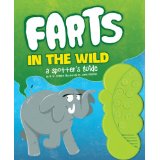
On her last trip to visit, she came bearing books for my almost-three-year-old son Luke.  The book that stole the show?  Farts in the Wild: A Spotter’s Guide.

Yes.  She bought my son a fart book.

And he LOVES it.

This little gem details farts from the smallest creatures (goldfish) up to the largest creatures (elephants), with eight lovely additional animals in between.  It could be slightly educational as it also provides facts and stats about each creature’s farting habits, but that’s not what Luke likes about it.

Off to the side of the text is a panel with ten little buttons on it.  Oh, yes.  Push the buttons and you will hear a sample of the corresponding creature’s fart accompanied by the creature’s distinctive call.  The goldfish blubs, the cat meows, the elephant trumpets, but they all fart.

A preschooler’s dream.

A parent’s worst nightmare.

And yet…

As I watched Luke play with this book on day eight (yes, I was definitely counting the days), I realized he was doing something interesting with it and not just pressing buttons randomly anymore.  Luke had his music player next to him, and he had This Old Man on repeat.  As the song played, he pressed the number that the singer sang.  Woah, I thought. That’s kind of cool.  And on day nine, I watched Luke unfold his fingers one by one, counting as he pressed the ten little buttons.  Woah. That’s even cooler!

In true preschooler fashion, Luke turned an otherwise annoying toy into something pretty cool.  And, as an added bonus, without any outside help, it became something educational.  Authentic, self-directed learning at its finest.

So, even though I’d rather not hear animal farts all day long, I do have to admit my own lesson learned about the amazing capacities of children and the endless possibilities of books.

I’d love to hear about how your child repurposed an old or uninspired book.  Please leave a comment!

Mama’s Corner: The Thought of Raising a Girl–Revised

So, my husband and I are expecting a baby girl any day now now have a baby girl (Brynn!).  To be frank, when I first found out that this baby was going to be a girl, I was scared shitless.

Sure, I’m female, but as anyone who knows me will attest, I’m not exactly normal, and the thought of raising a girl in this day and age seemed like a Herculean task.  So, I did what I always do when I don’t know what to do: I started reading.  I read The Feminine Mystique, Mighty Be Our Powers, Cinderella Ate My Daughter, Rescuing Girlhood, and Pink Brain Blue Brain.  I read blog articles, sought out girl-power websites, and perused newspaper op-eds.  I talked to other moms and dads of girls.  Next to none of it helped.  In fact, the picture seemed even bleaker than before.  Mass marketing, pigeon-holed pink and purple clothing, insidious commercials, Disney princesses, risque clothing for first graders?!  How do I raise a girl in such a gender-specific world? At last, I gave up reading.

And I thought, instead.  I thought about all of the little girls that I know.  Even with a small sample size, I know girls who climb better than boys, who are more physical than boys, who love cars and trains, and who still wear pink.  I thought about the little boys that I know.  I know boys who read better than girls, who speak better than girls, who have tea parties with their grandmas, and who still love cars and trains.  I also thought about all of the confident, self-possessed, intelligent young women and men that I met in my eight years of teaching.  Young women and men who bucked the stereotypes and pressures of high school cliques and were purely and simply their own people, true to their ideals and their goals for themselves.

In the end, I took to heart the two bits of advice that I could glean from all of the reading and talking and thinking that I did.

First, every child is unique.  The most obvious epiphany ever, right?  Even my own son Luke is not like any other boy we know, so why would I expect to think of my daughter any differently?  She will be unique.  Her own person with her own agenda, just as Luke is.  Following her lead will be my joy and privilege, just as it has been with Luke.

Second, talk.  The idea that open communication is the key to, well, pretty much everything.  If I talk to my daughter about the shows she watches, the clothing she wears, the idols she adores, then I have the chance to help her become a critical consumer of the world.  And teaching her (heck, both her and Luke) to think instead of just blindly follow is, I believe, my most important job as a parent.

I never thought I’d say this, and I know the people who know me well are going to laugh at me, but for maybe the first time in my life, I’ve decided to keep it simple.  Raising a child is difficult enough as it is, right?

To My Son on Mother’s Day: A (Bookish) Love Note

Dear Luke,

Until I started teaching, my relationship with reading was almost an entirely selfish one.  When I began sharing literature with my students, reading became two dimensional: analyzing a text with others and sharing my passion for a piece added an undeniable richness to the experience. Since I started reading with you, however, the act of reading has achieved a third dimension that is absolutely intoxicating.  What is it about this third dimension that is so amazing?  Allow me to try to explain.

Before you, reading was all about absence.  Escape.  Removing myself from the “real” world and submerging myself in another.

After you, reading has become all about presence.  Being fully present in every moment of our reading time.  Reveling in your curiosity, your questions, your observations, your undeniable interest in letters, numbers, words, and stories.  Paradoxically, by immersing myself in our reading time, I achieve the same sense of escape from reality, but it is with you as my traveling companion.

Before you, reading was about being alone.  It was a solitary act.  Even when reading a novel with high school students, the students were expected to come to class having read a portion of text and then we would discuss it.  Usually, we did not read the text together.

After you, reading has become about being together.  With you, I have discovered the pleasure of sharing words and ideas much more viscerally.  In an immediate way that was never possible with students, except for an occasional close reading done in class, together you and I explore the nuances and details and questions and morals of your stories, each of us interacting closely with the other.

Before you, reading was primarily a self-investment.  It was about me.  Through critical thinking about ideas, close analysis of beautiful writing, and pure enjoyment of a well-told story, I could return to myself and reestablish my identity as a thinker and a student of the human experience.  (Reading by myself still plays this role, albeit on a much smaller scale…for now!)

After you, reading has become an investment in YOU.  An investment in your future.  I hope that you are soaking up a love for words, stories, and ideas; cultivating a passion for the act of learning, for knowledge, and for beauty; and developing the insatiable curiosity, the ability to make connections, and the thoughtfulness that will bring you both great personal satisfaction and serve you well as a citizen of the world.

Before you, Luke, I really enjoyed the act of reading because it was fun.

After you, I love reading because it helps me grow closer to you.

At the beginning of this letter, I wrote about how reading with you has opened up an intoxicating third dimension. Why so intoxicating? I think I’ve figured it out.  Reading with you is done with Love.

Love,

Mama

Baby Signs and Nurture Shock: Why Baby Signs Work


I loved using baby signs (simplified sign language) with Luke.  From when he was born, and knowing full well that I wouldn’t see a return sign for many many months, I did signs as I read even the simplest books with him.  Bird, fish, lion, cat, sheep, dog.  I felt that it was engaging for both of us, and the authors of Baby Signs (the book that I used as a reference), Linda Acredolo and Susan Goodwyn, laid out convincing anecdotal and research-based rationales explaining why signs were worthwhile for creating life-long readers (clearly, a passion of mine).

But I never really understood how they worked.  Because they did work.  Luke didn’t ever use all 50 or so signs that I eventually had in my repertoire, but he certainly understood most of them, and he loved using and watching them as we read.  I’m convinced that he paid more attention to the letters and words on the page because of baby signs, and they helped him understand the abstract, symbolic nature of language.  I know that signs were part of the reason why Luke could recognize his letters by 16 months, read words by 18 months, and read sentences by 24 months.

I recently finished a book called Nurture Shock  by Po Bronson and Ashley Merryman.  The book references new brain research that debunks many firmly-held parenting beliefs, including beliefs about language acquisition.  Many parents have heard that talking to babies is invaluable for a language acquisition head start.  But what the research shows is that simply inundating babies with words is only part of the story.  There are actually a few different things that, when used together, can make language acquisition even easier for babies.

1) Speak in “parentese”: Yup.  That funny voice you use when you exaggerate the pitch of your voice and elongate parts of words.  It helps babies  begin hearing how words are made of distinct sounds and makes the sounds easier to imitate.

2) Use “motionese”: Using a distinct motion for a word helps baby link the object you’re naming and the word you’re saying.

3) Response time: According to Bronson and Merryman, even more important than the sheer number of words spoken to a baby is the response time between a baby looking at an object or making a sound of interest in something and the parent’s reaction or labeling of the object.  Five seconds is about the window before a baby’s attention lags.

So, although Bronson and Merryman don’t specifically link these three ideas to baby signs, the ideas sure do go a long way toward explaining just why baby signs are so effective.  When you read using baby signs, you repeat the words used with signs in “parentese,” you perform a motion with your hand that helps baby focus on the word, and because you’re always on the lookout for any kind of baby sign from baby as you read, your response time to baby’s unspoken questions is short.  And voila!  You’ve just kick started language acquisition.  Cool, right?