“I would be most content if my children grew up to be the kind of people who think decorating consists mostly of building enough bookshelves.”
—Anna Quindlen
Kicking my legs like a donkey. Dancing to get a bug out of my shirt. Pressing a yellow dot to see what happens to it. Gleefully yelling, “NO!” to repeated appeals from a pigeon to drive a bus.
Interactive books are a fantastic way to easily engage little readers (even the most rambunctious). Unfortunately, as my Mama and I have found, they are difficult to do well. Some “interactive” books have fuzz to feel, doors to open, slots to slide, or buttons to push, but these gimmicks often add very little to the story, and they don’t have much staying power for me. The very best interactive books, however, manage to do a much better job of using manipulatives or interaction to enhance or even become the story. These are the books that I return to over and over again.
By no means an exhaustive list, here are a few of my favorite interactive books in order from least to most complex. I dislike putting ages on these books because I read them at many different stages for many different reasons, and other children deserve not to be pigeonholed, too.


Happy reading!
–Luke (blog co-start, age two and a half)
I love funny books. I especially enjoy books with surprising twists at the end, and the more surprising, the better. My Dada is always VERY excited about surprise endings (and by that I mean LOUD!), but my Mama is very good at explaining or asking me why the endings are surprising (she doesn’t seem able to entirely purge herself of her English teacher tendencies). I like reading with both of them because of these different styles.
Good books always have some kind of resolution at the end, but there are always those few special authors who seem to have a knack for creating better surprises than the rest. Here are a few of my favorites over the past two and a half years. They are ordered from less complex to more complex words/phrases/concepts, but I return to even the simplest books every once in awhile just because they’re still funny.
 Peek-A Who?
 by Nina Laden: Page after page of surprises, with the very best surprise at the end! For the littlest readers.
  But Not the Hippopotamus (Boynton on Board)
 by Sandra Boynton: Lots of repetition that I picked up on pretty quickly, and I love the last two pages. Two surprises! Mama likes the clever rhyme.
  Where Is the Green Sheep? by Mem Fox and Judy Horacek: Tons of neat things to talk about in this book: colors, activities, counting sheep, and of course, the burning question, “Where is that green sheep?!” The big reveal is on the last page.

 I’m The Biggest Thing in the Ocean!
 and I’m the Scariest Thing in the Castle
 by Kevin Sherry: These two books follow a similar pattern, but they are different enough that I liked them both. I still like to read Scariest Thing in the Castle every now and again.
  Caps for Sale: A Tale of a Peddler, Some Monkeys and Their Monkey Business
 : The surprise in this book actually comes in the middle of the book. When I first started reading this book (we read the board book version first), Mama and I talked about the colors of the peddler’s hats and counted them, too.
 The Monster at the End of This Book (Sesame Street) (Little Golden Book) by Jon Stone and Michael Smollin: A classic starring lovable, furry old Grover, but I love it because it’s interactive and lends itself to a very dramatic reading.
  Pssst!
 by Adam Rex: A girl visits a zoo one day and the animals start asking her for things. She has no idea why she’s gathering all of this strange stuff, but we get to find out at the very end. I read this book over and over again right around when I turned two. Love it!
  Jumpy Jack & Googily
 by Meg Rosoff and Sophie Blackall: My Mama gets the biggest kick out of this book. She keeps talking about “irony.” Despite the weird weighty word, however, I think it’s pretty funny myself and have been known to repeat the punchline ad nauseam. Mama uses different voices for the two characters (a scared, jumpy snail who thinks that there are monsters hiding everywhere and his friend, Googily, who happens to be a monster himself), and they’re pretty funny, too.
 Happy reading!
–Luke (blog co-star, age two and a half)
The first short list of my favorite books from when I turned one to when I turned two:


Mama’s note: This last book was a stretch for Luke, but it exposed him to more advanced vocabulary, sentence structure, and plot line. He requested it multiple times a day for a very long time. We wore out the renewals at our library (12 weeks all told), and then I finally bought a copy. My first record of us reading it was at 12.5 months, and we read it six times that day!
Happy reading!
—Luke (blog co-star, age two and a half)


My Mama and Dada are fools. Wait. Perhaps I should clarify. My Mama and Dada act like fools when they read with me. They’ve acted this way since they first began reading to me, and it’s part of the reason why I love reading with them so much. They add noises wherever they possibly can. They add noises that don’t even exist in real life, all so I will engage in the books they read. And the noises work! I love books with lots of possible sound effects, and now that I’ve begun my own pretend play scenarios, I use the sounds myself.
Here are some of the books that provide plenty of opportunities for both animal sounds and other noises that my Mama and Dada read to me when I was really little:
 : Not just animals, but all sorts of fun sounds
 by Sandra Boynton: Counting dogs and their barks–what could be better?
 by Sandra Boynton: Great animal noises–ham them up!
Here are a few books that I liked when I got a little older:
 by Eric Carle: Good opportunities for animal sounds
 by Alice Schertle and Jill McElmurry: Animal sounds, but also lots of friendly “beeps!” and a grumpy dump truck voice
 by Helen Oxenbury and Michael Rosen: Good book for repetition and “other” noises beside animal sounds
 by Penny Dale: Dinosaurs, all different kinds of cars and trucks (with great sound effects), and a surprise at the end. The illustrations are fantastic, too!
Here are a few other sounds that my Mama and Dada use throughout the books we read:
Act the fool! Add sounds wherever you can. They draw in little guys and gals like me and help us really enjoy reading with you!
–Luke (blog co-star, age two and a half)
Mama: To all parents: If you haven’t read any Mo Willems books to your child yet, then you should run out and buy some because they are really good.
Luke: Mama, I think we need to tell people why Mo Willems’s books are so good, don’t you?
Mama: You go first, Luke.
Luke: Ok, fine. Here are my top five reasons why Mo Willems’s books have been among my favorites for over two years now:
5. Elephant and Piggie books are all really funny and easy enough to read for a beginning reader, but my favorite is I’m a Frog! (An Elephant and Piggie Book)
4. “1, 2, 3 Peeeeeee!” has become our household mantra during potty training. (Time to Pee!
3. The pigeon makes a cameo appearance in every Elephant and Piggie book, and I love searching for him.
2. The Duckling Gets a Cookie!? (Pigeon)
1. Don’t Let the Pigeon Drive the Bus!
Your turn, Mama.
Mama: Thanks, Luke. I really like how specific your reasons are. Ok, so here are my top five reasons why Mo Willems books have been a staple in our house since before Luke turned one.
1. There is an inherent appeal to books that are funny, and Mo Willems has a knack for being funny. Even more impressive, however, is the fact that he is so funny in so few words. Therein lies his mad genius and the main reason why I appreciate his books on an adult, literary level…brevity is the soul of wit, etc.
2. The Pigeon books fill a very specific niche in early literacy development: Very simple text written in big type; simple, expressive illustrations; an endearing character; and, as Luke mentioned, simple storylines that are absolutely hilarious. Even to adults.
3. Willems’s Knuffle Bunny books fill another niche in early literacy development. More complex sentences, pictures, and storylines lend these books to read-alouds with the more advanced toddler set. In addition, the pictures/illustrations are interesting and just that: a combination of photography and illustration that a visually interesting to look at for both toddlers and adults. Luke is not as enamored of these books as he is of Willems’s others.
4. The Elephant and Piggie books are our new favorites. Since Luke has started reading simple books on his own, these books’ big type and simple sentences, yet longer, more complex character interactions are the perfect match for his abilities. And they are very funny. Gerald (the elephant) is a serious worry-wart, while his friend Piggie is fun-loving and adventurous, and their exchanges are truly comical.
5. Did I mention that Willems’s books are just plain funny?
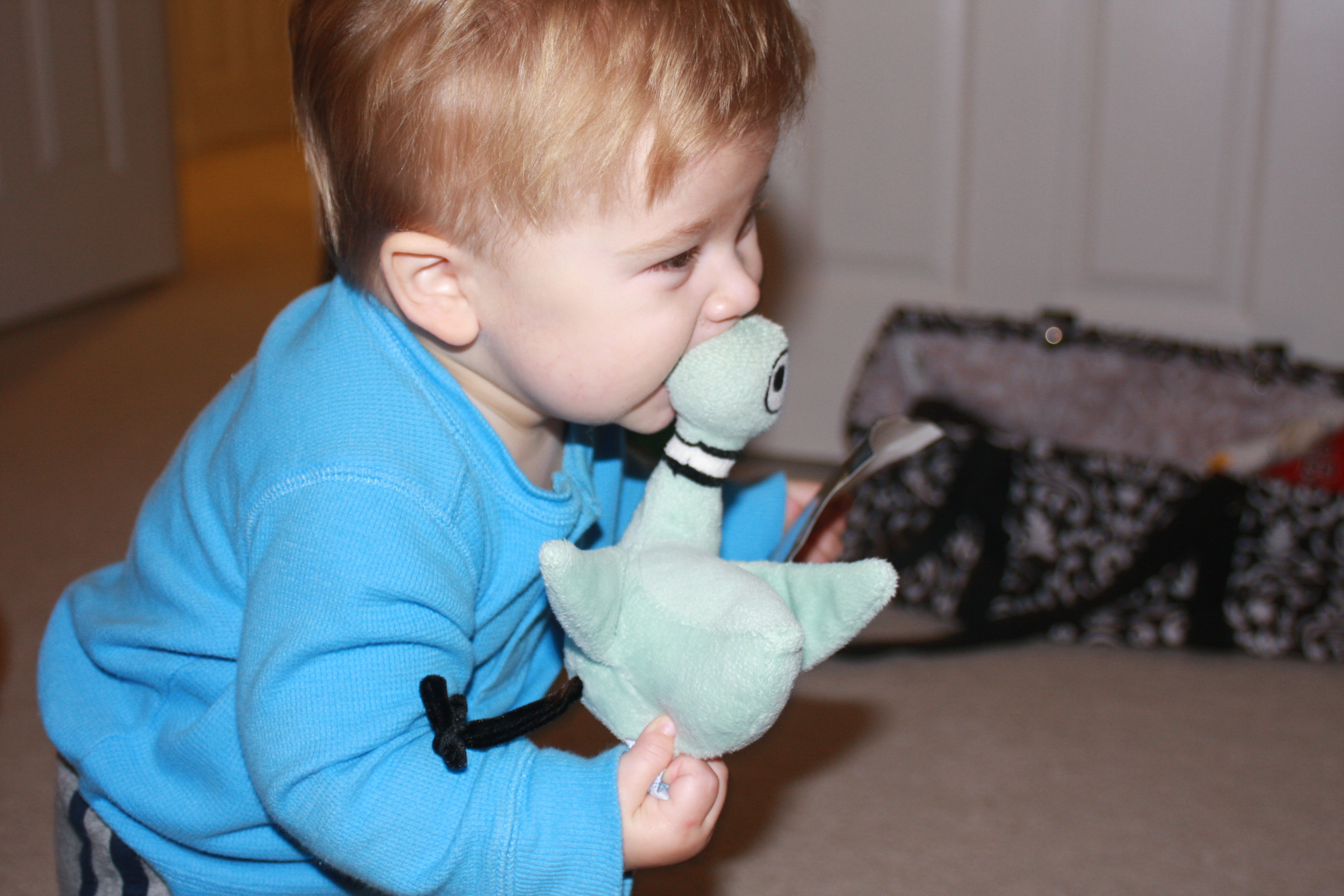
Luke (14 months old) and Pigeon
Mr. Brown Can Moo, Can You : Dr. Seuss’s Book of Wonderful Noises (Bright and Early Board Books)
The Very Hungry Caterpillar by Eric Carle
The Fo

Pajama Time! (Boynton on Board)
For more information about why my Mama and Dada used baby signs and lots of other hand motions while reading with me, see the Mama’s Corner post from March 25, 2014: Baby Signs and Nurture Shock: Why Baby Signs Work.
Happy Reading!
–Luke (blog co-author, age two and a half)
I loved using baby signs (simplified sign language) with Luke. From when he was born, and knowing full well that I wouldn’t see a return sign for many many months, I did signs as I read even the simplest books with him. Bird, fish, lion, cat, sheep, dog. I felt that it was engaging for both of us, and the authors of Baby Signs (the book that I used as a reference), Linda Acredolo and Susan Goodwyn, laid out convincing anecdotal and research-based rationales explaining why signs were worthwhile for creating life-long readers (clearly, a passion of mine).
But I never really understood how they worked. Because they did work. Luke didn’t ever use all 50 or so signs that I eventually had in my repertoire, but he certainly understood most of them, and he loved using and watching them as we read. I’m convinced that he paid more attention to the letters and words on the page because of baby signs, and they helped him understand the abstract, symbolic nature of language. I know that signs were part of the reason why Luke could recognize his letters by 16 months, read words by 18 months, and read sentences by 24 months.
I recently finished a book called Nurture Shock by Po Bronson and Ashley Merryman. The book references new brain research that debunks many firmly-held parenting beliefs, including beliefs about language acquisition. Many parents have heard that talking to babies is invaluable for a language acquisition head start. But what the research shows is that simply inundating babies with words is only part of the story. There are actually a few different things that, when used together, can make language acquisition even easier for babies.
1) Speak in “parentese”: Yup. That funny voice you use when you exaggerate the pitch of your voice and elongate parts of words. It helps babies begin hearing how words are made of distinct sounds and makes the sounds easier to imitate.
2) Use “motionese”: Using a distinct motion for a word helps baby link the object you’re naming and the word you’re saying.
3) Response time: According to Bronson and Merryman, even more important than the sheer number of words spoken to a baby is the response time between a baby looking at an object or making a sound of interest in something and the parent’s reaction or labeling of the object. Five seconds is about the window before a baby’s attention lags.
So, although Bronson and Merryman don’t specifically link these three ideas to baby signs, the ideas sure do go a long way toward explaining just why baby signs are so effective. When you read using baby signs, you repeat the words used with signs in “parentese,” you perform a motion with your hand that helps baby focus on the word, and because you’re always on the lookout for any kind of baby sign from baby as you read, your response time to baby’s unspoken questions is short. And voila! You’ve just kick started language acquisition. Cool, right?
Tickle Time!: A Boynton on Board Board Book
Mary Engelbreit’s Mother Goose: One Hundred Best-Loved Verses
Alphabet (


Pssst!
Posted by Luke (blog co-author, age two and a half)


 morebooksmama