In honor of my Mama’s mid-life political revolution and her participation in the Women’s March on Washington, I (Brynn) have compiled a list of my favorite awesome-girl books. Some of these characters are brave, others are wicked smart. Some are insanely creative, while others are simply willing to speak their minds. All of them are my heroes and paint a vivid picture of what a little girl like me might aspire to someday.
The books are arranged from least to most complex.


 Madeline by Ludwig Bemelmans: Madeline is certainly a classic, and every girl should have it on her shelf. Madeline is fearless in the face of mice, lions, her classmates, her headmistress, and surgery. Her classmates all want to be like her, and so do I!
 Stand Tall, Molly Lou Melon by Patty Lovell, illustrated by David Catrow: Molly Lou Melon is short. REALLY short. And she has buck teeth. REALLY big buck teeth. And her voice sounds “like a bullfrog being squeezed by a boa constrictor.” Squeezed REALLY tightly. Fortunately, Molly Lou Melon has an awesome grandma who gives her outstanding advice to always be loud and proud and confident and the world will love her. When Molly Lou Melon moves to a new school and a bully teases her, her grandma’s advice is put to the test in the funniest of ways. Great illustrations and snappy text make this book hilarious.

 Mud Puddle by Robert Munsch, illustrated by Dusan Petricic: Both my brother and I are huge fans of Robert Munsch’s stories, and while all of his stories have spunky child heroes, this story and the next are particular favorites of ours. In Mud Puddle, Jule Ann is in a predicament: every time she ventures outside, she is trounced by a mud puddle. She tries various ways to outsmart the villainous mud puddle, but at one point, she is crouched by the back door, too afraid to even stick her nose out. That’s when she has a brilliant idea: soap! A funny, fabulous book that both my brother and I have asked our parents to read time and time again.

 The Paper Bag Princess by Robert Munsch, illustrated by Michael Martchenko: This book is another Munsch classic. The awesome heroine, Elizabeth, confronts and outsmarts a castle-burning, boyfriend-stealing dragon in nothing but a paper bag. But when she rescues said boyfriend, he doesn’t even thank her. Instead, he criticizes her looks, so she gives him the boot and goes skipping off into the sunset by herself. This final illustration has become the iconic seal for all of Robert Munsch’s classic stories. My mom always laughs out loud at the very last line when Elizabeth tells Prince Ronald, “but you are a bum.” Love it!
 My Name is Not Isabella by Jennifer Fosberry, illustrated by Mike Litwin: This book functions more as a history lesson than a traditional children’s story. The main character, Isabella, repeats the phrase, “My name is not _____. My name is ______.” And she substitutes names of influential women in history. Each woman is described in a few words, but there are no real details about the women until the brief biographies at end of the book. I like this book because it introduces me to important female figures through the eyes of a young girl like me.

 Ladybug Girl by David Soman and Jacky Davis: Ladybug Girl is an awesome character, and these books are some of my very favorite. Ladybug Girl dresses in a tutu and ladybug wings, but she is also imaginative, brave, adventurous, friendly, and helpful. These books show that girls can wear tutus and still be amazing at the same time–just like me! The illustrations are fabulous, too!

 Rosie Revere, Engineer by Andrea Beaty, illustrated by David Roberts: Books about girls who do cool things are at the top of my list, and this book is one of the best. Rosie loves to create gizmos and gadgets in the middle of the night when no one can see and make fun of her attempts. One day, her great, great aunt Rose comes to visit. She gives Rosie an idea that will not let her be, so in the middle of a sleepless night, Rosie builds her first flying machine for her aunt. It crashes, but before it does, it flies…just a little. When Rosie wants to give up and never try again, her aunt tells her that you never truly fail, unless you quit. Great message, great premise, great character, great illustrations!

 The Red Wolf by Margaret Shannon: Both my brother and I like this book. He actually read it to me the other night! Roselupin is a princess who is kept locked up in a tall, stony tower by her father, the king. He doesn’t want her to be hurt by the outside world, so he keeps her completely separate from it. One day, a mysterious box appears for Roselupin’s birthday. In it are balls of yarn along with a note that says, “Knit what you want.” So she does. She knits a red wolf suit, whispers some magic words, and “poof!” she transforms into a giant red wolf. This first taste of freedom is only temporary, however, as she accidentally transforms back into a girl and her father locks her up again. That night, though, Roselupin hits upon a more permanent solution…and wins her freedom for good. A great story of empowerment and clever thinking.

 Willow by Denise Brennan-Nelson, illustrated by Rosemarie Brennan: Willow is a girl who loves art. When she runs into an art teacher who does not appreciate her purple trees and crazy snowpeople, she doesn’t get mad and she doesn’t get sad. Instead, she gifts her teacher with her favorite art book that is chock full of art that defies reality. Her teacher has a turn of heart, and Willow’s gentle insistence that the world can be seen in many different ways is an inspiration in a world that is sometimes depressingly black and white. Willow is my art-hero!
 Bloom by Doreen Cronin, illustrated by David Small: This book is the longest and most complex picture book on the list, and it is likely more appropriate for children who are 4-5 years old. Bloom tells the story of kingdom made of glass that has been built up with the help of a fairy called Bloom. The people of the kingdom soon forget that the fairy helped them, and they shoo her away. As soon as the kingdom begins to crumble, however, they are desperate for her help again. The King and Queen both visit her, but when Bloom lays a bucket of mud at their feet and claims that it is the solution, they both recoil and run away. Finally, they decide to send someone “ordinary,” a small girl called Genevieve, to coax the fairy into helping them. When the fairy lays the bucket of mud at her feet, she hems and haws for awhile before deciding to give it a shot. Bloom then teaches Genevieve to make bricks, out of which they build a house. She takes her knowledge back with her and shows her King and Queen how to rebuild the kingdom. Genevieve comes to realize that she has enormous power and that there is no such thing as an ordinary girl. A powerful message for all girls to internalize.

 Pinky Dinky Doo by Jim Jinkins: Pinky Dinky Doo is an amazing girl with a crazy imagination. In this series, she makes up all kinds of outlandish, creative stories for her little brother. The stories contain multiple choice questions, search and finds, and matching pages. The illustrations are pretty neat, with photograph backgrounds of a generic house overlaid with cartoon figures, and they help to underscore the main message of the series: anyone, including the reader, can create stories, too.
Girls Rock!  Happy Reading!
-Brynn (age 2.5)
Clicking on the pictures of the books will take you to Amazon.com. If you purchase a book, a small portion of the sale comes back to me. I, in turn, will donate profit back to a children’s literacy effort in my area. Thank you!


 We Forgot Brock! by Carter Goodrich: I (Luke) love this book, and my mom says that it’s one of her all-time favorite children’s books, too! It’s a wonderful story about a little boy, Phillip, who has an imaginary friend, Brock, whom he accidentally leaves at the fair one night. Brock meets a little girl with an imaginary friend of her own, and she takes him home with her until they finally find Phillip. In the end, the four become great friends. The best part of this book, however, are the illustrations. Phillip and the rest of the “real” characters are done in color–beautiful, soft, amazing color–while the “imaginary” characters are done in cartoonish black and white. The contrast is stunning. If you’re looking for quality picture books, this book is one for the shelf.
 Yak and Gnu by Juliette MacIver, illustrated by Cat Chapman: There are some children’s books that you read and think, “I could have written that!” And then there are others that you read and marvel that the author could have come up with such a clever text. Yak and Gnu is one of the latter. Simply put, it’s a book about friendship. But the text is so clever that it elevates the book above most others that we’ve read. The text rhymes, except when it doesn’t, and those few places are used to emphasize the growing realization that there are many other animals who pilot their own water crafts, just like kayak-paddling Yak and the canoe-loving Gnu. But in the end, the friends realize that “There’s nobody else quite like you!” I (Luke) love this book because of the song that Yak and Gnu sing throughout the book. Anything with music has me completely hooked. Mom loves this book because it tickles her inner English teacher with the use of non-rhyming lines to emphasize the message. The illustrations are also very well done. I am giving this book to several of my friends this year!
 A Squiggly Story by Andrew Larsen, illustrated by Mike Lowery: I (Luke) have read this book with my mom and by myself a dozen times since we borrowed it from the library this month. It’s about a little boy who can’t write very many words, but he can write enough letters and squiggles to start a story of his own, just like his big sister. Any story that deals with the imagination and creating something is a story that I’m interested in, but this book captured my interest in particular because the little boy doesn’t know how to start his story, and he gets stuck multiple times. It’s not easy for him, but his big sister encourages him by saying that he’s the boss of his own story. I like that idea. Maybe some day I’ll write my own books for others to review!
 Teeny Tiny Toady by Jill Esbaum, illustrated by Keika Yamaguchi: Dr. Seuss is a master of rhyme. The King of children’s books. A genius on so many levels. Teeny Tiny Toady reminds me of Dr. Seuss. High praise, I know, but the rhyme has a beautiful flow to it and Esbaum uses creative not-quite-words just as Dr. Seuss did. The story is about Teeny, the smallest girl-toad in a family of big strapping brothers. One day, Mama Toad gets picked up by a human boy and stuck in a bucket, and it’s Teeny and her brothers who have to save her. The brothers try their hardest, but they really aren’t very bright, and they never listen to Teeny’s ideas. In the end, after her brothers fall in themselves, it’s up to Teeny to save her Mama AND her brothers from the bucket. An awesome story about a spunky little she-toad who saves the day with her brains instead of her brawn. For little people like me, it’s a satisfying message. The illustrations are beautiful, too! Another high-quality picture book for the shelf.
 Maggie and Wendel Imagine Everything by Cori Doerrfeld: This book is one that both Brynn and I (Luke) loved. The text is incredibly simple, just a few words on each page, but the adventures of these two siblings are incredibly complex. Maggie is the older sister, but she really enjoys playing with her younger brother Wendel. Together, they create imaginative play scenarios that keep them endlessly entertained. They don’t always get along, but they do manage to make up on their own (something that fascinated both Brynn and me). Clever, spare illustrations allow the reader a look into the play worlds that Maggie and Wendel create together. A great book for siblings!
 The Acrobat by Alborozo: Both Brynn and I like this book. The text is simple enough for Brynn, but the story is engaging enough for me, and the surprise embedded in the climactic illustration toward the end is amazing and beautiful enough for anyone. The story is about a struggling acrobat who decides to leave the circus one day and ends up in a park. There, he tries trick after trick to entice the children to pay attention to him, but something else always draws them away. Until a colorful bird arrives and alights on the acrobat. Then another bird arrives. And another. And another. Soon, the acrobat is covered in birds of all colors. The kids are all watching now. Suddenly….pow! The acrobat leaps up, scattering the colorful birds in all directions (the illustration is stunning–Brynn and I both look at it for a long time)! A very neat book.
 No, No, Kitten! by Shelley Moore Thomas, illustrated by Lori Nichols: Hi! Brynn writing now! My turn! This book is one of my favorites from this year. I liked this book for several reasons: One, it has a cat in it, and I love cats. Two, the cat doesn’t listen to her owner, just like I don’t listen to my mom (most of the time). And three, the cat asks for all kinds of things that she shouldn’t have (again, just like me!) (like a helmet and lasers) and then uses those things to blast off to space. As a reader, you don’t know what all of these items are going to be used for until the countdown to liftoff starts. I love surprise endings! Illustrations are done by Lori Nichols of Maple fame and are whimsical and expressive.
 Harry and Walter by Kathy Stinson, illustrated by Qin Leng: My mom is not quite sure why I love this book so much, but it’s true, I love it! The story is about an almost-five-year-old little boy, Harry, whose best friend is a 92 year old man, Walter, who lives next door. They ride lawnmowers together, play games together, build snowmen together, and drink hot chocolate and talk together as they watch the snow fall. It’s a beautiful friendship…until Harry’s family has to move. There is a surprise ending again, which I love, but really, I like this book because I love my grandparents and this book shows me that I can be best friends with them.
 The Nuts: Sing and Dance in Your Polka Dot Pants by Eric Litwin, illustrated by Scott Magoon: “Polka dot pants, polka dot pants, sing and dance in your polka dot pants!” Sing it with me! Eric Litwin in an interactive picture book genius. I didn’t think he could do any better than the original Pete the Cat books, but this book is pure fun. One rainy day, Hazel Nut decides she wants to sing and dance in her polka dot pants, but no one will play with her. Not Dad, not Mom, not little brother. Who does Hazel eventually call to save the day? Grandma, of course! I love the song that is repeated throughout the book, and I love doing the polka dot pants dance that’s at the end of the book. So much fun! I’m definitely giving this book to a few of my friends this year!
 Mom School by Rebecca Van Slyke, illustrated by Priscilla Burris: This book would make a great gift for any mom with small kids. It’s about a little girl who imagines that her mom went to school to learn how to be a great mom. At Mom School her mom learned to bait a hook, throw a ball softly, ride roller coasters, grow vegetables, and decorate cupcakes. And even though her mom has a job that she goes to every day, her favorite job is “being my mom.” I enjoy reading this book with my mom because she talks about the things that she knows how to do that she still has to teach me, like putting a worm on a hook and playing the violin. I love that these kinds of conversations can emerge from books!
 Ladybug Girl and Bumblebee Boy: About two friends negotiating what and how to play–very important budding skills for preschoolers and Kindergartners.
 The Amazing Adventures of Bumblebee Boy: About older brother Sam learning to play with his younger brother–Luke and Brynn are likewise discovering the pains and joys of playing with a sibling.
 Ladybug Girl at the Beach: About Lulu’s day at the beach and how she gradually works up the courage to play in the water–Luke is scared of the ocean right now, so he’s been reading this book often.
 Ladybug Girl and the Big Snow: About Lulu’s adventures in the snow. She gets very frustrated because everything is much harder in the deep, soft snow, but she perseveres and turns her day into a great one. Luke likes how Lulu plays with her brother and builds snow creatures.
 The original Ladybug Girl: I don’t know how many times Brynn has used the phrase from the book, “I’m not too little!” And she loves Lulu’s dog, Bingo.


 by Bill Martin, Jr. and Eric Carle. We sing the words to Twinkle, Twinkle. Setting the words to music helps to emphasize their rhythmic nature and makes them more appealing.
 by Sandra Boynton, where the book is a song, and
  by Margaret Wise Brown, which is a compilation of lullabies. Other times music complements the words, as in
  by James Dean and Eric Litwin and
  by Jan Thomas. Still other times, as in
  by Michael Rosen and Joel Stewart and
  by Sandra Boynton, music plays a minor role but helps me hook into the book.
 by Margaret Mahy and Polly Dunbar and


 because the turn of events at the end makes me laugh every time.
 )
) This book’s main character, the duckling, has an ingenious way of off-loading his nut-laden cookie onto his less-than-mature nemesis, the pigeon.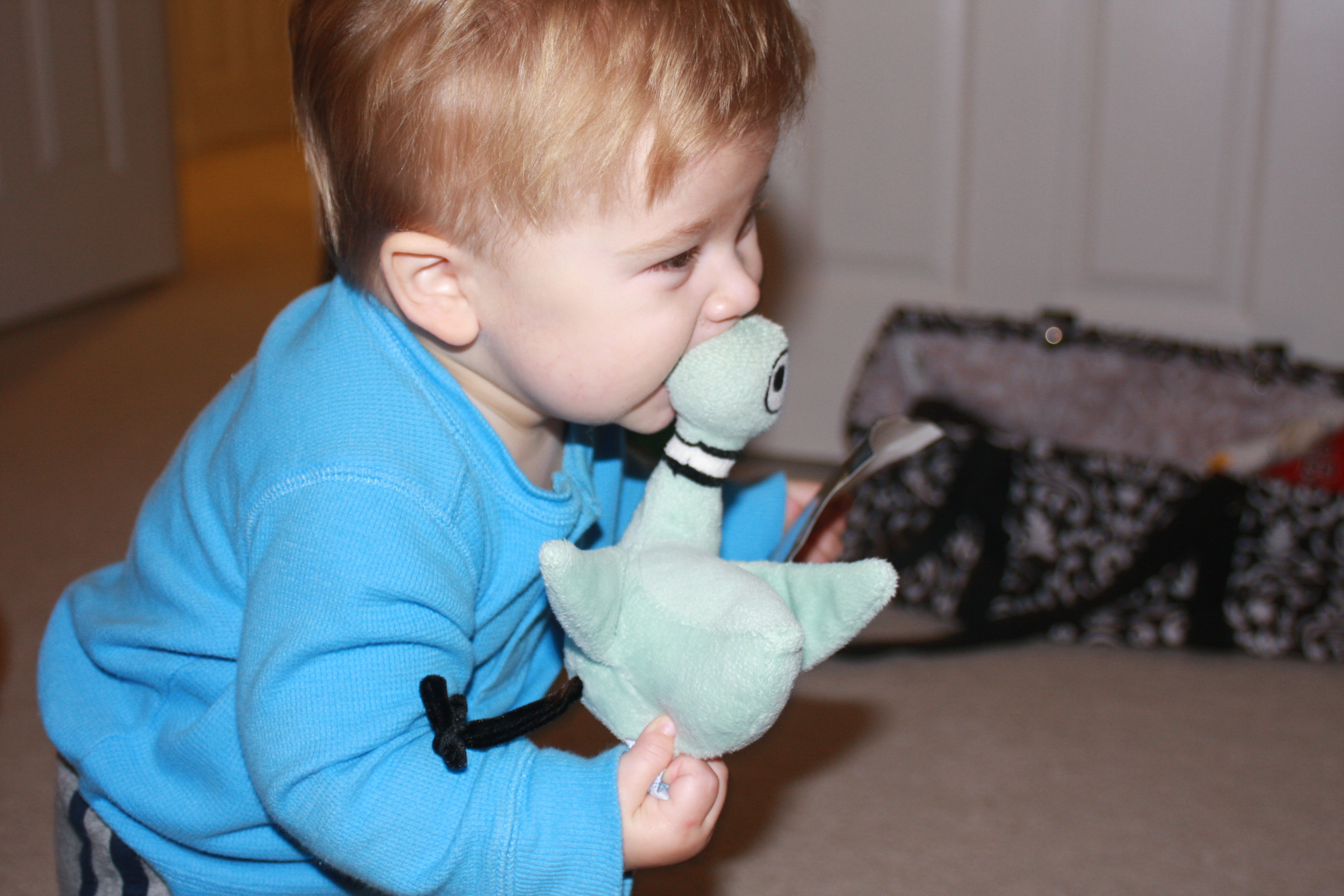
 morebooksmama